

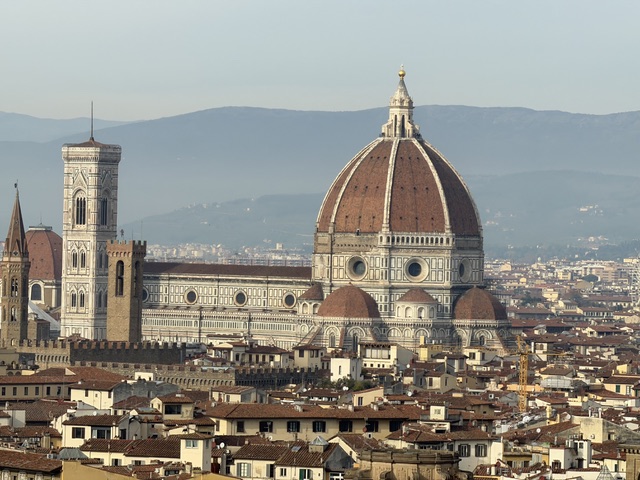
Duomo di Firenze
It’s that time of year again… time for a trip to Italy!
September is my favorite time to head over to Italy as the summer crowds are gone and the weather is still pretty good, even up north.
This year we are heading to Milan and Lake Garda.
We’ll fly into Milan Malpensa airport, stay in the historic center for a couple days, and then take a train over to Desenzano Del Garda where we’ll be staying.
From previous trips, I learned it is a good idea to be on the lookout for transit worker strikes.
Just about every month of the year you can expect some sort of travel disruption in Italy due to a strike.
My research indicated that a strike among train and ferry workers is expected on the Friday after we arrive starting in the evening and extending into Saturday night.
I also learned there is a potential air traffic controller walkout on the day we are to fly home, but not until after our flight is scheduled to depart.
When you are booking a trip to Italy, you will not have this information far enough in advance unless you are someone who books their trips just a couple weeks ahead of time.
Therefore, you need to check about a week before you are ready to head over.
With all that said, here are some more tips for traveling to Italy based upon my multiple trips over the last several years.
Tip #1 – Fly direct
If you are flying to Italy from North America, I highly recommend flying direct to Rome, Milan and Naples if possible.
Now and then there are opportunities to fly direct to other cities, but these are typically from the New York area airports.
The reason for this is to avoid layovers at major airports such as London Heathrow, Paris, Munich and Frankfurt. These airports are massive and you will need to get through customs at one of these airports before connecting to your destination in Italy.
Due to the size of these airports, it is easy to miss your connecting flight, even if your flight is on time!
In Munich last year we witnessed one gentleman miss his connecting flight because it took him over two hours to get through customs.
This happens because these flights often occur on large airliners, and if more than one land at the same time, the lines to get through customs can be quite long.
And unfortunately, the people working security do not really care if you miss your connection. It’s not their job to help you in that regard.
Tip #2 – If you can’t fly direct, use the 3 hour layover rule
Many people are traveling on a budget, and direct flights to Italy are not the cheapest. You will find much cheaper flights that involve connecting flights and layovers.
The problem is that when you are searching for flights on the flight aggregators, they will often give you options that include a layover of less than two hours.
For example, one time I was flying back home from Rome and had a connecting flight in Frankfurt, Germany.
I did not book the trip and did not pay much attention to the schedule until the trip started and I noticed that our layover was going to be less than about 50 minutes.
After we flew over via Frankfurt, I knew we would be in trouble. It is a huge airport, and from the time you land until the time the plane actually parks can take 15 to 20 minutes.
Then you have to work your way to the right terminal for your flight home and that can take another 20 to 30 minutes, not including getting through customs and security!
Fortunately, we lucked out in that our flight was on time and we were able to breeze through customs due to no line. We were among the last to board our flight.
The other issue is that is not unusual for your initial flight to be delayed. I had this issue on a trip to Sicily in 2023. My flight to London Heathrow was delayed, but I didn’t get notified until I was on the road to the airport.
As a result, my trip was re-routed and I missed a full day in Sicily due to the delay in the arrival.
Therefore, if you need to save money by using a connecting flight, or there are no direct flights to your first destination from the airport you are using, then use the 3 hour layover rule. It won’t work every time but it puts the odds of making your connection in your favor.
Tip #3 – Learn to travel by train
Traveling by train is a great way to get around Italy, especially between the major cities.
For instance, you can get from Rome to Milan by train in about three hours, and travel comfortably.
However, there are a couple things to know about train travel in Italy, which I hinted at earlier.
First, train workers in Italy love to go on strike, and according to locals, this is usually a way of getting a long weekend vacation.
There are train trips that are almost always exempt from these strikes, such as a high speed train from Rome to Florence or Milan.
However, I learned the hard way that these strikes typically affect routes where regional trains are involved.
Fortunately, train strikes are announced about two weeks in advance, and there is also a list of the exempt trips you can find when needed.
Another issue when traveling by train is there are often delays, and these can impact your trip as well.
Therefore, you should always stay in the city in Italy in which you first arrive for a day before moving onto your next destination and then stay in the city of your departure on your last full day.
The second point is especially important.
In 2023, my wife was in Bologna and flying back home out of Rome.
The train trip was supposed to be about 2 1/2 hours. It took over four hours and she still had to get off that train and then take the train from Roma Termine to the airport.
She ultimately was the last person to board her flight!
Tip #4 – Do not plan activities for day of arrival
The first point here you should already understand… there is a good chance you will miss your activity if you have something planned on the day of arrival.
These days, it just seems likely that transportation will cause a delay of some kind.
However, even if you arrive on time, getting to Italy involves a long trip.
From Washington, DC where we fly from, it is an 8 1/2 hour flight.
When you add in the time to get through the airport before your flight and after you arrive, and then getting to your accommodations, it just makes sense to relax the rest of that day.
The goal is to enjoy Italy, not be exhausted for your entire trip!
Tip #5 – Use Skip the line tickets to see attractions
Always get your tickets to see primary attractions in advance, so you can bypass long lines.
This is especially true for such attractions as the Colosseum in Rome and The Vatican.
Skip the line tickets usually involve a tour guide, whom you will meet with at a designated time. If you are in a large group, once you get inside, you may even ditch the group if you like.
However, some tours are actually quite informative, so the choice is yours.
Tip #6 – 7 day minimum trip length
Italy is best experienced with a relaxed vibe. It is just not very fun rushing from one site or activity to the next just to check off a bucket list.
If you are traveling to Italy from North America, you must understand that getting there and coming back effectively takes a full day each.
This is especially true if you are traveling to places such as Sicily, Puglia and Sardinia, where direct flights from North American are not very common.
Therefore, try to block off ten full days for your trip so you have at least seven to eight days of fun.
There is so much to see and do, no matter where in Italy you go, you will want time to explore each place on your itinerary.
Tip #7 – 3 days in Rome, 3 days in Florence
The typical Italy itinerary will package Rome and Florence with Venice. If you stay longer, you may hit Naples and the Amalfi Coast.
With that said, I highly recommend taking at least three days to explore Rome and Florence due to all of the sites you will likely want to see in each city.
Unless you need to see every museum, you can see what you need to in Venice in two days or less.
I’ve now spent a total of seven full days in Rome and eight full days in Florence and feel like I’ve seen everything I need to.
Tip #8 – Try to walk as much as possible
If you are physically able to, the best way to see any town or city in Italy is on foot.
This is how you find hidden gems that may be important to you.
My wife loves to shop and in particular loves to shop in secondhand stores and smaller boutiques with local products.
Because we rely on our feet to get around the towns we visit, she has found a couple of cool little shops in our travels, particularly in Florence.
This is also the best way to find restaurants that are generally serving the locals more than the tourists.
Really good restaurants are often found on less traveled alleys, rather than on the main thoroughfares where all of the tourists are found.
Surprisingly, even Rome is quite walkable for the able bodied.
Tip #9 – Rent a car for seeing Tuscany and other regions
If your goal is to see Tuscany, and some other less traveled regions such as Umbria, Abruzzo, Le Marche, etc., then you will want to rent a car, as the train system is not reasonable for travel between many small towns.
Most of the regions in Italy are the size of smaller states in the U.S. The small towns within some of these regions cannot be reached by train, so you would need a bus from the train station to get to many small towns.
In Tuscany, popular towns such as Montepulciano, San Gimignano and Montalcino are among those that are not directly accessed by train.
Adding a bus trip just adds another layer of transportation onto your trip, so renting a car is probably a better option.
This is especially the case if you are traveling with young children and/or more than a couple pieces of luggage.
Renting a car is no more difficult than it is here in North America, but you’ll need to get your international drivers permit ahead of your trip.
Discover Cars is one service I recommend for renting a car in Italy.
Tip #10 – Don’t try to see everything on your list
The best way to experience Italy is to take your time.
Yes, there is so much to see and do in Italy, but you will miss what the country is all about if you are rushing from activity to activity and town to town.
And Italians really don’t like it when tourists are doing that. Italy is not just about checking a box.
My conversations with local Italians indicate that they want you to take your time and enjoy their country at their pace.
Family and friends are what are most important to Italians. That means conversation over coffee, after work, at dinner, etc.
And Italians love it if you can speak some of their language, which brings me to my last, and best tip for traveling to Italy.
Tip #11 – Learn some Italian
I will admit that the Italian language is difficult for me to learn.
My wife has immersed herself in it for almost three years now and speaks it well enough to speak to people wherever we go.
I have to admit it is really fun for me to sit back and watch her converse with local Italians, and they enjoy speaking with her as well.
She always gets compliments as her accent and pronunciations are pretty good.
I personally use Babbel and Duolingo to learn Italian, while Robin uses services in Italy since she is more advanced.
Final Thoughts – Tips for traveling to Italy
And there you have it… my best best tips for traveling to Italy.
I am sure I will add more to this list over time as we typically head over there at least once each year.
However, these tips will surely help you plan a trip to Italy when you are ready.
The key is to stop thinking about it and start planning!
Now get to it!
Discover more from Scott Allan Cole
Subscribe to get the latest posts sent to your email.






Leave A Comment